Long-form / 深度專題
疫症如何改寫香港城市
How epidemics remade the city
由鼠疫到沙士,香港嘅疫症史反映咗咩制度問題?
1894 年鼠疫暴露華人聚居區同西人區嘅衛生落差;2003 年沙士則暴露醫院同屋苑污水系統嘅漏洞。每次疫症之後政府都增設制度,但下一次仍然會出現新缺口。
約 4 分鐘 · 6 節 · 16 條時間線 · 4 份文獻
English
1. 1894: an epidemic is not merely a natural event
On 4 February 1888 the Government introduced compulsory smallpox vaccination for children aged six months to 14 who had lived in Hong Kong for at least six months — the first epidemic law in Hong Kong. The legal tool therefore existed before plague: the question was whom it reached and how thoroughly it was enforced.
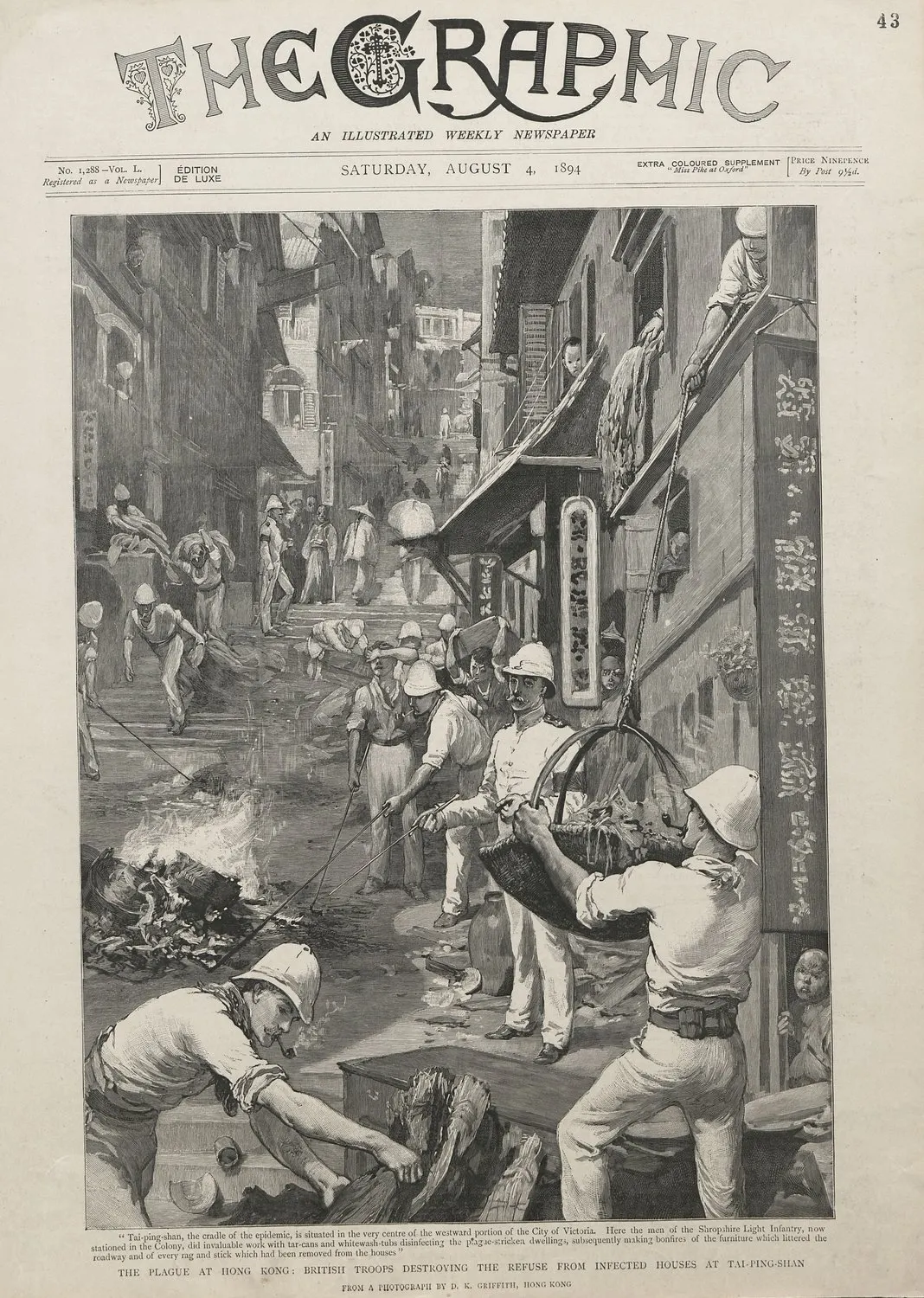
Plague broke out in 1894 and hit Taipingshan hardest. The record gives two death totals: 2,552 in one place, “more than 2,000” in another. The colonial medical report also gives case fatality rates of 18.2 per cent for Europeans and 93.4 per cent for Chinese. That gap should not be read as the pathogen being more virulent in one group; the more reasonable reading returns to housing — who lived in crowded Taipingshan buildings, and who lived higher up, away from the outbreak. That is this site’s interpretation; the source gives the rates only.
After the outbreak the Government began a large-scale cleansing programme known as “washing Taipingshan”, which lasted until 1954. An epidemic response became six decades of urban sanitary governance. That institutional afterlife matters more than the death toll: once established, it reshaped streets, buildings and water management for generations.
2. 1961: cholera, an infected port and water
In 1961 a cholera outbreak forced the Government to declare Hong Kong an infected port. The decision mattered beyond public health: for a port city, that status affected shipping, cargo and travellers through quarantine arrangements.
Two years later drought compounded the problem. Water rationing lasted 360 days across 1963 and 1964, and at its tightest supplied water for only four hours every four days. The official account adds that the lack of clean water in summer worsened sanitation and increased cholera, dysentery and typhoid. That sentence links water policy to epidemic control: water is not a convenience but a precondition of public health.
3. 2003 SARS: hospitals, an estate, and institutions
On 10 March 2003 SARS broke out at Prince of Wales Hospital, infecting medical staff and marking the start of Hong Kong’s outbreak. On 22 March the University of Hong Kong announced that the cause was a coronavirus. On 17 April the Government published the Amoy Gardens report: 321 infections between 14 March and 15 April, with transmission confirmed through the sewage system. The finding put hospital infection and estate drainage side by side; epidemic control could no longer be only about wards.
The totals need care: the record gives 1,755 infections and 299 deaths, plus 386 healthcare workers infected and eight deaths. These are different scopes, not figures to add or subtract — healthcare workers are part of the total, not an extra group. The last confirmed case was on 11 June. On 2 October the expert committee reported that the healthcare system had been inadequate in the early stage and made 46 recommendations, including a Centre for Health Protection.
The institutional change after SARS was not merely another agency. It turned surveillance, reporting, isolation and hospital infection control into routine procedure. Whether that worked could only be tested by the next outbreak — and in 2020 the first case arrived by high-speed rail, showing that ports and transport nodes remain the first gate.
4. 2020: the first case, and the limits of this dossier
On 23 January 2020 Hong Kong confirmed its first COVID-19 case. The milestone records that it arrived from Wuhan by high-speed rail, and that the Government expanded health declarations and suspended Wuhan flights the same month. The entry matters because it puts cross-border transport and epidemic control at the same point in time: sixteen months after the express rail link opened, it became the route of the first imported case.
This dossier will not pretend to cover the whole pandemic. The archive is thin on public-health measures after 2020, and this site has not verified mask, distancing, vaccine or care-home arrangements item by item. The boundary is deliberate: depth is not the same as breadth, and unverified years are left blank.
5. How to read the sources
For plague, read the chronology p.563 (death totals and the dedicated medical unit), p.348 (case fatality rates) and pp.261–262 (the cleansing programme). For cholera, see Nature: Natural Resources and Ecology p.567; for rationing and sanitation, Nature: Natural Environment p.599 and Natural Resources and Ecology p.35. For SARS, read the chronology pp.601–605: p.601 for the coronavirus and contact checks, p.602 for Amoy Gardens, p.603 for healthcare-worker infections, and p.605 for totals, the last case and the expert committee.
The 2020 first case rests on a single government press release, with no book page. Cite it as a press release, not as a page of the Hong Kong Chronicles. For further research, go to Centre for Health Protection annual reports, Hospital Authority annual reports and LegCo health panel papers rather than headlines alone.
6. Gaps
The 1894 plague has two death totals (2,552 / more than 2,000) and their definitions have not been reconciled page by page. Confirmed case and death counts for the 1961 cholera outbreak are not covered, nor are the later COVID-19 years, vaccines or care-home arrangements. These gaps stay visible rather than being smoothed over with a phrase about a severe epidemic.
The practical next step is to check the definitions of “case”, “death” and “case fatality” against each annual report, then compare like with like. The three are not interchangeable; keeping them separate is what makes it possible to say how severe an outbreak was rather than how severe it felt.
Gaps
- The two 1894 plague death totals have not been reconciled page by page.
- Confirmed case and death counts for the 1961 cholera outbreak are not covered.
- Later COVID-19 years, vaccines, care homes and distancing measures have not been verified item by item.
- Long-run data on hospital beds, staffing and infection control are outside this dossier.