Long-form / 深度專題
公營房屋:由安置災民到產權階梯
Public housing: from disaster relief to an ownership ladder
香港嘅公屋同居屋,最初係為咗解決咩問題?
1953 年石硤尾大火之後,安置一夜之間變成長期建屋;1970 年代房委會成立、居屋出現,公營房屋由「住得落」逐步變成「買得到」。每一次轉向都留下未解決嘅供應同公平問題。
約 4 分鐘 · 6 節 · 14 條時間線 · 2 份文獻
English
1. Why start at Shek Kip Mei
Hong Kong’s postwar housing problem begins with a number rather than a policy: between 1948 and 1953 the squatter population rose from 30,000 to 350,000. That increase reflected not only arrivals but also formal housing supply falling behind. In January 1952 the Government had already made a resettlement-area regulation under emergency powers, so the legal instrument existed before the fire; what was missing was the shock that made the Government use it at scale.
On the night of 25 December 1953 a fire swept through the Shek Kip Mei squatter area for six hours, over 41 acres. Three people died, 51 were injured, 2,580 huts were destroyed and more than 50,000 people lost their homes. Another official volume records 53,000 households made homeless. The two totals do not agree; they may count affected people and registered victims differently, and this site has not reconciled them page by page, so they are set side by side and never added. Four days later the Government issued an emergency land-resumption regulation for 58,203 registered fire victims and designated 8.5 hectares for their resettlement — relief had become a question of land and construction.
2. From emergency shelter to a resettlement system
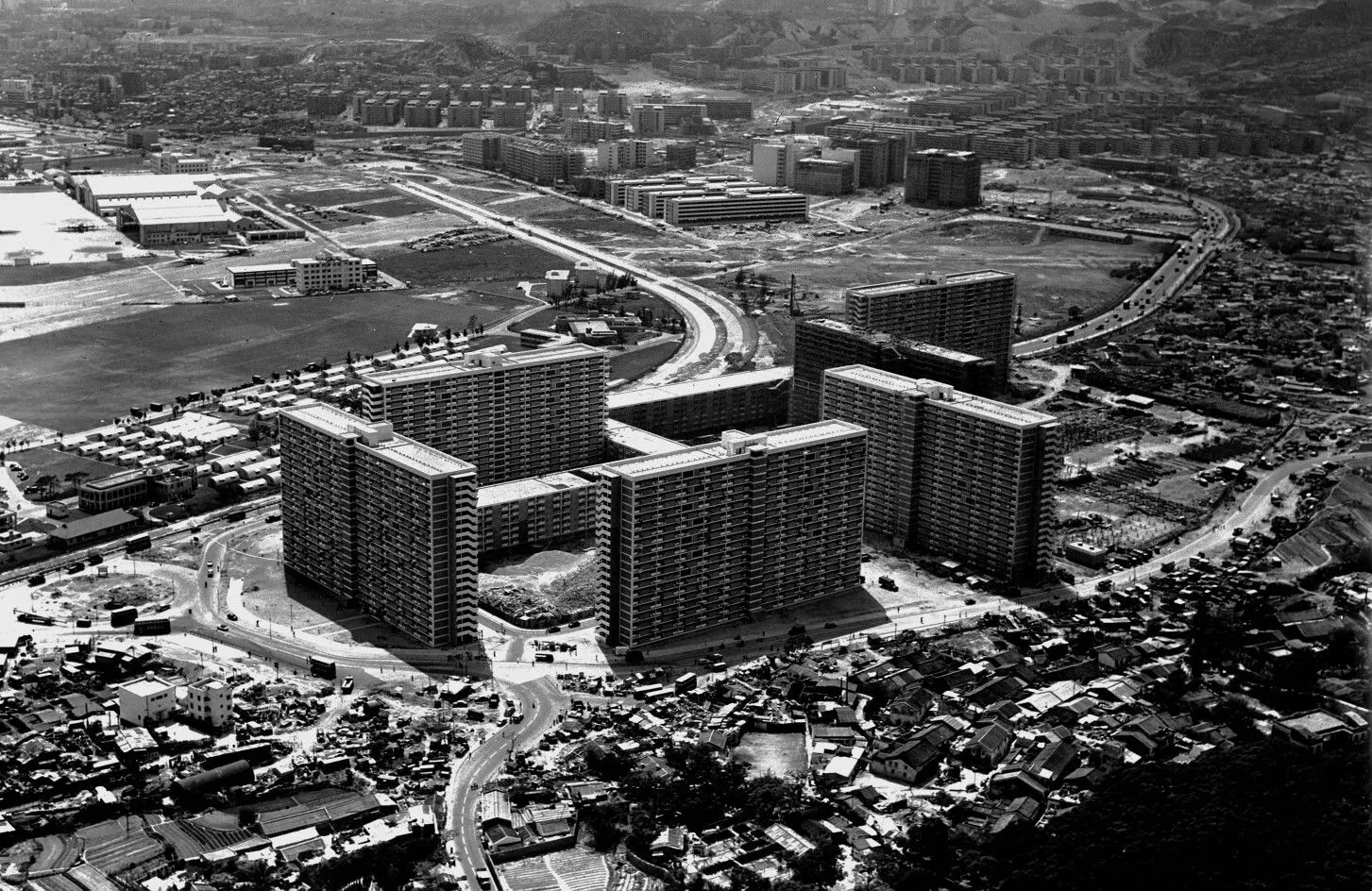
In 1954 eight Mark I resettlement blocks were completed on the fire site, among the earliest buildings of their kind in Hong Kong. In April the Government created the post of Commissioner for Resettlement; in June it set up the Resettlement Department. The significance was not simply speed: resettlement became an administrative programme with a dedicated department, standard plans and designated sites. Over the following years the resettlement-area population rose from 45,906 in 1954 to 87,519 in 1961, then fell to 72,484 in 1967.
Read those three figures carefully. They cover “resettlement areas”, not all public housing estates, and they exclude housing built by the Housing Society and the former Housing Board. Comparing them directly with later public-housing totals produces a false conclusion that the public-housing population fell. This is the measurement problem the site keeps flagging: the same label can cover two different scopes in different volumes.
3. The Housing Authority and the Home Ownership Scheme
On 1 April 1973 the Hong Kong Housing Authority was established, taking over the design, construction and management of public housing across the territory; the Resettlement Department and the Housing Board were merged into the Housing Department. The arrangement put resettlement and subsidised ownership inside one system, allowing policy to move between renting and buying. On 6 October 1976 the Government launched the Home Ownership Scheme with a target of 5,000 units a year and an eventual total of 30,000; the first phase opened for applications on 15 February 1978.
The 1987 Long Term Housing Strategy set an annual target of 40,000 public rental units. In December 1997 the Housing Authority introduced the Tenants Purchase Scheme, letting tenants buy their flats at 12 per cent of market price. On 8 November 2002 the Secretary for Housing, Planning and Lands announced nine measures to stabilise the property market, including ending regular land auctions, halting subsidised housing and stopping the building and sale of Home Ownership Scheme flats from 2003. On 16 December 2014 a new Long Term Housing Strategy proposed a 60:40 public-private split and 480,000 units for 2015–2025.
Put in sequence, the policy turns are clear: public housing began as a resettlement tool, gained an ownership ladder in the 1970s, was briefly used as a property-market lever in 2002, and returned to supply targets after 2014. That sequence is this site’s reading, not a single sentence from the source volumes; every date and figure can be checked against the timeline and page references below.
4. Three unresolved questions
The first question is scope. The 1954, 1961 and 1967 figures cover resettlement areas only; the 1987 target covers public rental housing; the 2014 figure covers public and private housing together. They cannot be added, subtracted or treated as one series. The second is numerical disagreement. The 1953 fire produced different totals for people affected and people registered, and the 1894 plague has more than one death toll (see the epidemics dossier). These gaps are not simply errors; they are a warning to state which volume and which definition you are quoting.
The third is the distance between target and delivery. The 1987 target of 40,000 rental units a year and the 2014 target of 480,000 units over ten years are targets, not completions. This site has not verified delivery year by year, so it does not claim success or failure. A researcher’s next step is the Housing Bureau and Housing Authority annual reports and LegCo housing panel papers, comparing completions with applications.
5. How to read the sources
The most direct entry is the Hong Kong Chronicles chronology: p.294 for the fire and land resumption, p.296 for the eight resettlement blocks, p.384 for the Housing Authority, p.404 for the launch of the Home Ownership Scheme, p.411 for its first applications, p.471 for the 1987 Long Term Housing Strategy, p.558 for the Tenants Purchase Scheme, p.598 for the 2002 measures and p.694 for the 2014 60:40 split. Read in order, they show the policy turns.
Population and resettlement figures come from Hong Kong Chronicles, Nature: Territory, Geography and Population: p.335 for the 1948–1953 squatter population, pp.297–300 for resettlement-area totals and the Kowloon and Hong Kong Island breakdowns, and p.726 for the Resettlement Department. Copy the definition on each page; do not turn “resettlement area” into “public housing estate”. For primary documents, go next to Housing Authority annual reports and LegCo papers rather than second-hand web pages.
6. Gaps
This dossier does not cover waiting times, flat sizes, redevelopment and compensation, the roles of the Housing Society and Urban Renewal Authority, or actual completions against the 2014 target. The two totals for the 1953 fire have not been reconciled page by page either. These gaps are not filled with estimates; any future addition must start from an official annual figure with a registered source and reference date.
The next useful step is to set Housing Authority annual completions beside the Long Term Housing Strategy targets, separating public rental, subsidised ownership and private housing into three series. One historical essay cannot do that, but with official annual reports each cell can be checked without resorting to estimates.
Gaps
- Waiting times, flat sizes, redevelopment compensation and actual completions against the 2014 target are not covered.
- The two totals for the 1953 fire (over 50,000 people / 53,000 households) have not been reconciled page by page.
- The roles of the Housing Society, the Urban Renewal Authority and private participation schemes are outside this dossier.