Long-form / 深度專題
陸路交通:由青山公路到鐵路網絡
Land transport: from Castle Peak Road to a railway network
香港人日常搭嘅巴士、電車同鐵路,係幾時開始連成一個網絡?
香港嘅陸路交通唔係由鐵路開始:先有公路令土地可用,再有巴士專營權把公共交通變成規管對象,然後才有纜車、電車、九廣鐵路、跨海橋樑、地下鐵路、輕鐵同兩鐵合併。呢篇按「路—車—軌—網」四層講,每層接得返原書頁碼。
約 5 分鐘 · 7 節 · 15 條時間線 · 4 份文獻
English
1. Roads and buses: roads before factories, franchises after companies
Land transport in Hong Kong followed an order different from the usual impression: sea routes and piers first, then roads, and only later railways and a metro. Castle Peak Road opened along its entire length in 1919, after which sporadic industries were established in Tsuen Wan. The point of that official entry is that the road came before the factories: only when a road reached the land could it be used for industry and goods moved out.
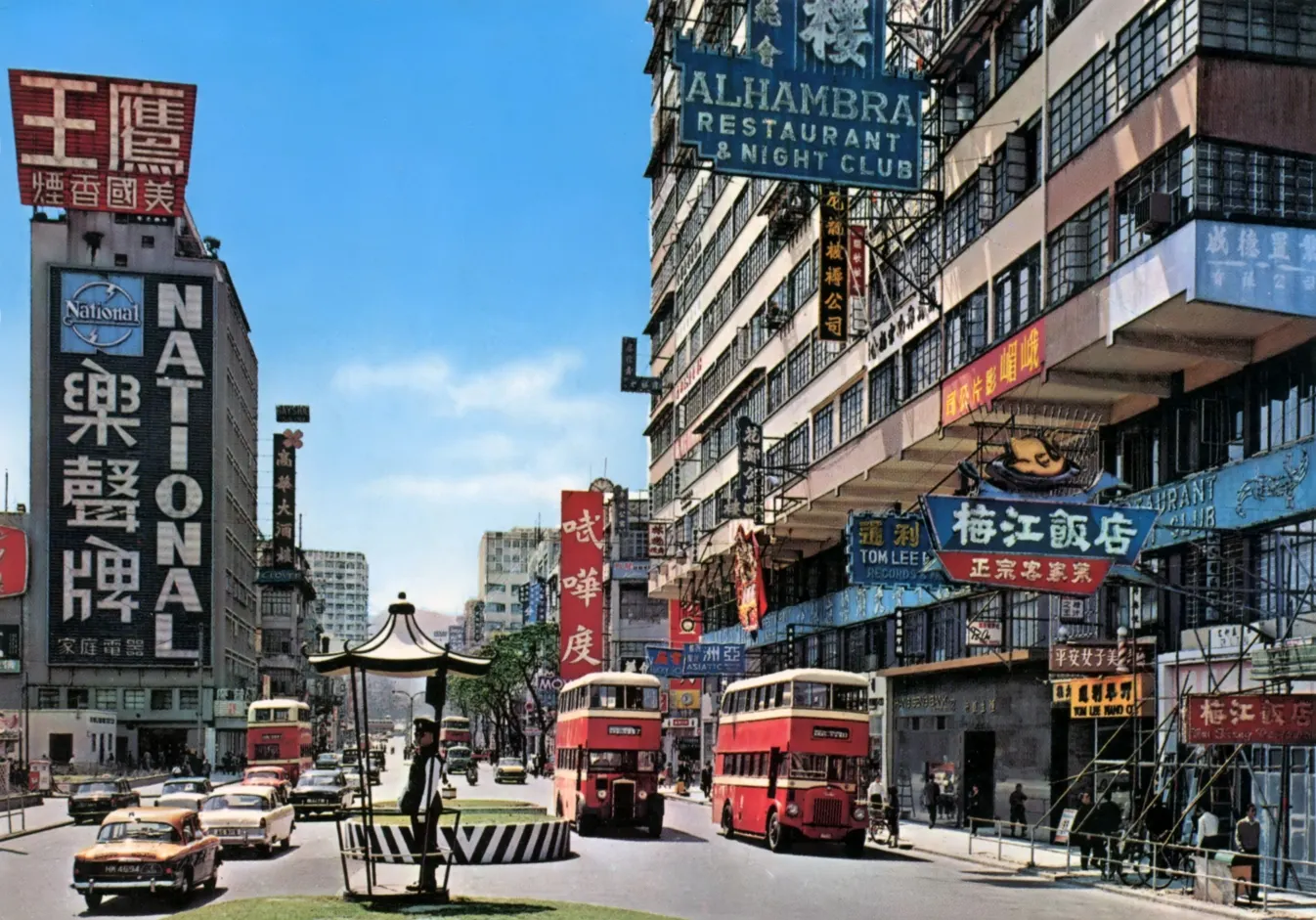
Buses appeared in the 1920s. On 2 September 1923 Ngan Shing-kwan founded the China Motor Bus Company, providing services on the Kowloon Peninsula and in the New Territories; in 1933 the company obtained the bus franchise for Hong Kong Island. Between a company doing business and a government granting a franchise lies a change of concept: public transport was no longer purely a trade but a public service requiring regulation.
On 13 January 1933 China Motor Bus and Kowloon Motor Bus each obtained franchises for bus services on Hong Kong Island, Kowloon and the New Territories for a period of 15 years, effective from 11 June that year. The arrangement split the bus market in two: the island to CMB, Kowloon and the New Territories to KMB. Franchising lasted to the end of the twentieth century and explains why the later expiry of CMB’s franchise was a major event — the fate of a route is the accessibility of a neighbourhood.
2. Track: the Peak Tram, trams and the Kowloon–Canton Railway
Rail actually came before roads. On 30 May 1888 the tramway connecting to Victoria Peak officially opened, becoming the first track-based public transport in Hong Kong’s history. Note the phrase “public transport”: the Peak Tram was built for residents and for getting up and down the hill, not as a sightseeing ride; it became a tourist fixture only later.
In 1904 the Hong Kong tramway opened, improving transport in the Eastern District. The tram’s significance lay in being cheap, frequent and street-level: it allowed people living in the Eastern District to travel to Central for work daily, forming Hong Kong’s first commuter belt. Its short stops and slow street running were a different urban form from the later railway, with long station spacing and high speed.
The Kowloon–Canton Railway came a few years later. On 1 October 1910 the 22-mile British section was completed and opened, thereafter serving as an important overland artery between Kowloon, the New Territories and Guangzhou. Its function differed from the tram: trams carried commuters, the railway carried people and goods across a border — New Territories farm produce and Kowloon cargo moved along it.
3. Crossing water and going underground: bridges, tunnels, metro
Crossing water was another threshold. On 29 October 1968 Lai Chi Kok Bridge was completed, 790 metres long and the first bridge in the territory to span the sea. The bridge turned “crossing the harbour” from a shipping question into an engineering one and built technical experience for later crossings, but a bridge solves point-to-point movement, not capacity.
The metro began on 3 November 1975, when construction started on the Central to Kwun Tong section of the Modified Initial System, 15.6 kilometres long. The background was that population and jobs had spread along the Kowloon peninsula and surface roads were saturated; the metro was not a supplement but an alternative — a dedicated track that turned commuting time from a road-condition question into a timetable question.
On 30 September 1979 Governor MacLehose presided over the opening ceremony for the first phase at Shek Kip Mei Station; on 12 February 1980 the section between Tsim Sha Tsui and Central opened, completing the Modified Initial System and becoming the first railway line to cross Victoria Harbour. From start of construction to crossing the harbour took a little over four years, a pace that contrasts sharply with later major rail projects.
4. Electrification, light rail and the rail merger
On 6 May 1982 the first phase of the Kowloon–Canton Railway electrification programme opened, with the journey between Hung Hom and Sha Tin taking twelve minutes and trains every ten minutes. The real significance of electrification was frequency: the same track could carry several times as many people, and passengers no longer had to plan around a diesel timetable.
New towns needed another kind of track. On 18 September 1988 the Tuen Mun to Yuen Long section came into service with the opening of Light Rail Phase 1. Light rail’s role was feeder service: bringing residents of the northwest New Territories to rail and bus trunk routes, and giving Tuen Mun and Yuen Long an option that did not depend on buses. That division between trunk and feeder later became the basic framework for new town transport planning.
Ticketing and institutions changed at the same time. On 1 September 1997 the Octopus card and its electronic payment system were launched, replacing the stored-value tickets the MTR had used; on 2 December 2007 the Kowloon-Canton Railway Corporation ended 97 years of railway operation and merged with the MTR Corporation, which then managed and operated the whole network. Moving from two companies and two ticket systems to one network and one card took a decade — institutional integration is usually slower than construction.
5. High-speed rail and unfinished business
On 27 January 2010 construction began on the Hong Kong section of the Guangzhou–Shenzhen–Hong Kong Express Rail Link, about 26 kilometres long. The controversy was not about engineering but about worth: station siting, cost and passenger forecasts are all questions of how public resources are allocated, and they do not disappear when the construction ends.
This dossier does not assess the cost-benefit of high-speed rail and does not add post-opening passenger numbers, because such figures need an official series and matching years to be comparable. The approach matches the other chapters: institutional milestones can be checked, outcomes must wait for data; where there is no data, the gap is stated rather than smoothed over.
6. How to read the sources
The Hong Kong Chronicles chronology is the main entry: p.173 (Peak Tram), p.197 (KCR British section), p.214 (China Motor Bus), p.226 (bus franchises), p.360 (Lai Chi Kok Bridge), p.399 (MTR construction), p.424 (first phase opening), p.426 (Tsim Sha Tsui to Central), p.439 (KCR electrification), p.479 (Light Rail Phase 1), p.554 (Octopus), p.647 (rail merger) and p.661 (high-speed rail construction).
The roads thread needs Hong Kong Chronicles, Nature: Territory, Geography and Population: p.87 records the 1904 tramway and improved Eastern District transport, p.145 the 1919 opening of Castle Peak Road and Tsuen Wan industry. To check today’s road network and rail lengths, use the registered Hong Kong: The Facts — Highways and Railway Network (July 2022), but those are current-state documents and cannot be used to infer historical dates.
7. Gaps
This dossier adds no patronage, fare or revenue figures: the operating definitions for buses, trams, the metro and light rail differ, and comparison requires year-by-year annual reports that this site has not verified.
Three further threads are left blank: the full timetable of franchise renewals and transfers, the cost and overruns of each new railway, and the effect of transport on land use (for example development above stations). All three are documented officially but are not verified page by page, so no figures are added to the prose.
Gaps
- This dossier adds no patronage, fare, revenue or fleet figures: the operating definitions of the four modes differ and annual reports have not been verified, so no comparison is made.
- The full timetable of franchise renewals, transfers and route reorganisations is not registered year by year; the expiry of the CMB franchise is mentioned but not developed.
- Construction cost, overruns and delays (including high-speed rail and the Sha Tin to Central link) are not verified item by item, and no total is added to the prose.
- The relationship between transport and land use (development above stations, new town density) is described directionally rather than quantified from official data.
- Sea routes other than ferries and trams, and cross-border land transport (control points, through trains), are handled in news and other dossiers and are not repeated here.
- Accessibility provision (lifts, platform gaps) is a separate layer, already covered by the accessibility dossier and the station-to-station journey layer, and is not rewritten here.