Long-form / 深度專題
社會福利與志願團體:先有善堂,後有部門
Social welfare and voluntary bodies: charities before departments
香港嘅社會福利,係由慈善團體做先,還是政府做先?
答案係慈善團體先。1870 年東華醫院奠基,1878 年四位華商上書港督請求查緝拐帶,兩年後保良局獲批准成立——喺政府仍未有一個福利部門之前,華人社會已經用善堂、義莊同保良局處理救濟、醫療同保護婦孺。政府要到 1947 年才設社會局,1958 年才把它升格為社會福利署;而現金保障就由 1973 年嘅傷殘老弱津貼一路走到 1993 年嘅綜援。呢篇講嘅正係「誰在做」同「誰付錢」兩個問題嘅分離過程。
約 5 分鐘 · 5 節 · 16 條時間線 · 3 份文獻
English
1. Charities first: Tung Wah’s foundation, Po Leung’s founding
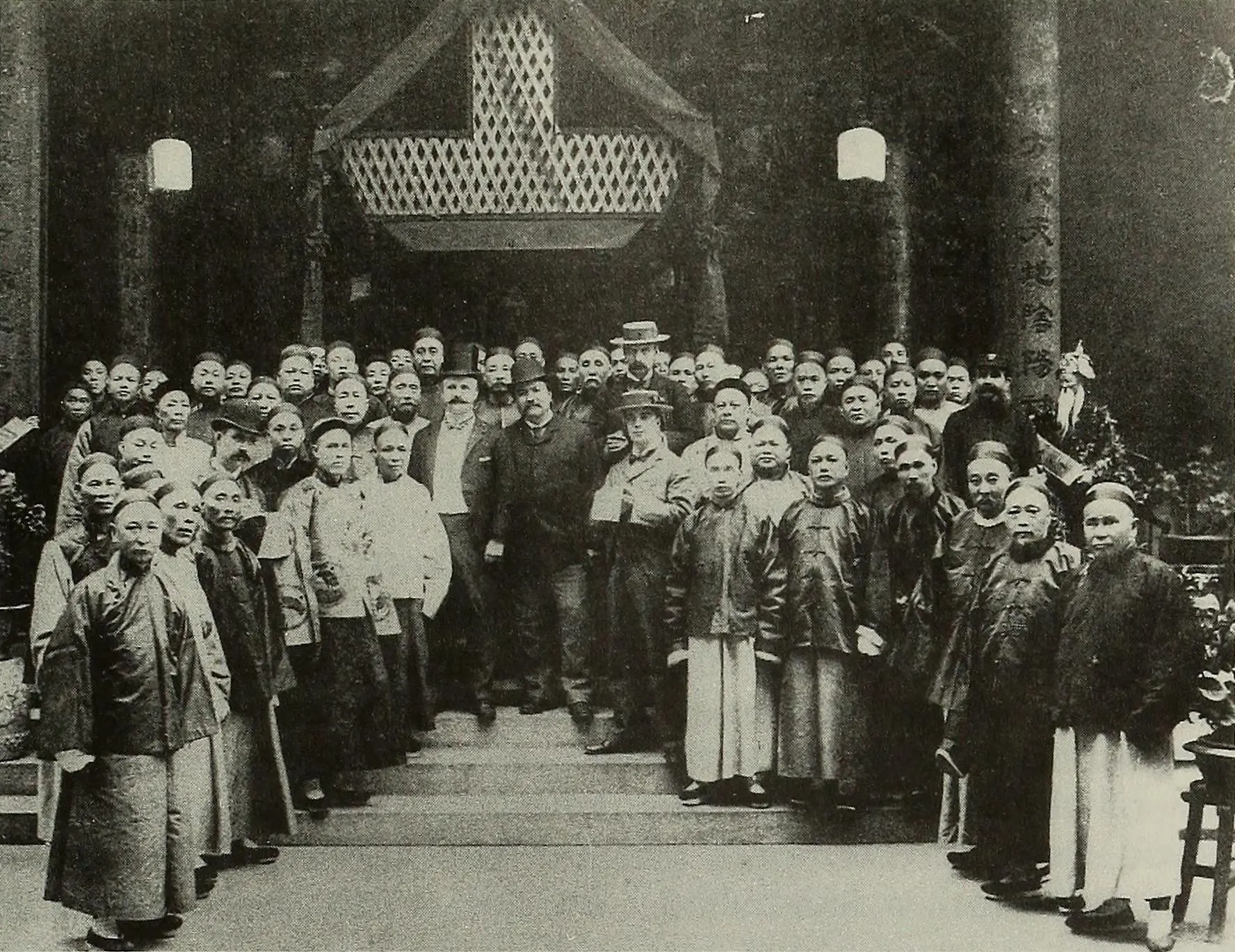
Hong Kong’s earliest social service providers were Chinese charitable organisations, and their rise is bound up with colonial rule. On 9 April 1870 the foundation stone of Tung Wah Hospital was laid by Governor MacDonnell — the Governor’s presence shows that this was not purely a private initiative but an arrangement run by Chinese merchants and recognised by the Government.
Po Leung Kuk’s origin shows the pattern even more plainly: a proposal from below, approval from above. On 8 November 1878 four merchants — Tse Tat-shing, Sze Sang-kai, Fung Po-hei and Lo Kang-yeung — petitioned Governor Hennessy for permission to raise funds and offer rewards against abduction, and that day became the Kuk’s founding anniversary. On 17 May 1880 Hennessy approved its establishment, and on 5 August 1882 a related ordinance was enacted.
At its inception the Kuk borrowed office space from Tung Wah Hospital, and its functions covered protecting defenceless women and children, preventing abduction, and helping the Protector of Chinese mediate family and marriage disputes. Read that list closely: medical care, protection and mediation were carried at once by one Chinese body, which meant part of public authority was exercised inside Chinese society. In 1931 Tung Wah Hospital, Kwong Wah Hospital and Tung Wah Eastern Hospital merged into the Tung Wah Group of Hospitals under one board, completing a horizontal consolidation of the charity system.
2. The Government takes over: from Social Welfare Office to department
The Government’s role was institutionalised only after the war. On 27 August 1947 the Social Welfare Office was established under the Secretariat for Chinese Affairs, and it later evolved into the Social Welfare Department. Note that subordination: welfare was first part of Chinese affairs, not a policy field of its own.
Eleven years later, on 1 January 1958, the office was separated from the Secretariat for Chinese Affairs, became an independently operating government department and was renamed the Social Welfare Department, responsible for social welfare matters. That is the watershed in Hong Kong’s welfare history: welfare moved from handling the particular needs of the Chinese population to being a general function of government.
A policy paper then supplied direction. On 13 May 1965 an official document on social welfare objectives and policies was passed by the Legislative Council, covering social security and social relief schemes and aimed mainly at young people. Its importance is that it turned welfare from relief into objectives — and objectives can be measured and questioned.
3. Voluntary bodies alongside: the Red Cross, the Community Chest and not taking government money
A government department did not mean voluntary bodies withdrew. On 12 July 1950 the Hong Kong branch of the Red Cross was established by the British Red Cross; in 1952 it launched a free voluntary blood donation programme, giving the blood collected to hospitals across Hong Kong free of charge. Blood donation deserves particular notice: it turned giving part of one’s body into a routine public service, run by a voluntary organisation rather than a government department.
On 8 November 1968 the Community Chest’s position was set out plainly: a non-profit charity receiving no government funding, whose main work is raising donations for social welfare agencies, which are its funding recipients. That three-part structure — public donations, Chest allocation, agency delivery — is a distinctive layer of Hong Kong welfare, and it explains why the lump-sum grant later changed the whole ecology.
Hong Kong’s welfare system therefore rests on three kinds of organisation at once: a government department (the Social Welfare Department), statutory and voluntary agencies (the Red Cross among them), and a fundraising intermediary (the Community Chest). Their accountability differs: the department answers to the legislature, agencies to donors and service users, the intermediary to the public. The advantage is pluralism; the weakness is that no one is accountable for the gaps between them.
4. Cash allowances: from the old age allowance to CSSA
If charities and voluntary agencies handled services, cash protection was a separate line: money handed directly to people. From 1 April 1973 the Government implemented the disability and old age allowance scheme, under which those aged 75 or above could apply for an old age allowance of $55 a month, while eligible disabled persons received an amount set by degree of disability, up to $110 a month.
The design had two features: a high age threshold and disability allowances graded by severity. Both reflect the thinking of the time — an allowance was a supplement for a needy minority, not universal protection.
On 1 October 1978 the Government introduced the Old Age Allowance: residents aged 70 or above who passed a means test received $100 a month, and the new allowance replaced the old age allowance that had begun at 75. Lowering the threshold from 75 to 70 was a clear step towards wider coverage, while the means test kept the selective principle.
On 1 July 1993 Hong Kong implemented the Comprehensive Social Security Assistance Scheme, replacing the Public Assistance Scheme. CSSA’s significance is that it consolidated cash assistance into one system, and the arguments since have circled it: whether amounts are adequate, whether the test is harsh, how the definition of household affects eligibility. Two smaller measures show that a welfare state also attends to convenience: from 1 April 1994 any resident aged 65 or above could apply for the Senior Citizen Card, and in October 1996 the Senior Citizen Home Safety Association launched a portable Personal Emergency Link giving round-the-clock response to solitary elderly people aged 70 or above, and to those aged 60 to 69 on CSSA with a critical illness.
5. After 2000: the lump-sum grant rewrites the agency relationship
On 10 February 2000 the SAR Government announced that subsidies and funding for social service organisations would thenceforth be provided as a one-off lump-sum grant, replacing the previous arrangement. Technically this changed a funding method; institutionally it changed a power relationship, since agencies could deploy resources themselves but also carried the risk on pay and service volume.
The change also altered the answer to “who is responsible”. Under item-by-item claiming, overspending was covered by the Government; under a lump sum, reserves and staffing are the agency’s own decisions, while public expectations of service levels do not fall accordingly. The same sentence — “services are insufficient” — can therefore point at the Government (the total grant), the agency (resource allocation) and the intermediary (fundraising capacity) at once.
From Tung Wah in 1870 to the lump-sum grant in 2000, Hong Kong’s welfare history has one clear thread: service provision moved from a single charitable system to a coexistence of government, voluntary agencies and a fundraising intermediary, and each reform redrew the line between flexibility and accountability. That line is still moving.
Gaps
- This dossier quotes no CSSA caseload, recipient or expenditure figures: caseload and persons are two different definitions, and reference periods have not been checked item by item, so no comparison is made in the prose.
- A complete historical series of allowance amounts is not compiled; the prose gives only the amounts at introduction as recorded in the source and does not extrapolate them to today.
- The number of voluntary agencies, volunteer hours and total donations are not verified, so the dossier does not claim how large the voluntary sector is.
- Waiting lists for welfare services (residential care, community care) exist only as current official material and have not been built into a time series, so they are not quoted.
- The actual effect of the lump-sum grant on pay structures and service volume is not quantified; only a directional, institutional description is given.
- For welfare arrangements during the Japanese occupation, the chronicle holds only scattered entries, and this dossier does not force them into a continuous narrative.