Long-form / 深度專題
邊境與人口:由自由往來到配額管理
Border and population: from free movement to managed quotas
香港同內地之間嘅人口流動,點解會由「行得過就過」變成配額、禁區同居留權審查?
1841 年,香港島人口 7,450 人;1941 年,因戰亂南來,人口升至 163.9 萬。1950 年羅湖建檢查站、邊界拉鐵絲網;1974 年實行抵壘政策,1980 年改為即捕即解。人口從來唔只是數字,而係邊境制度、勞動市場同身份權利嘅交會點。
約 4 分鐘 · 6 節 · 19 條時間線 · 3 份文獻
English
1. 1841–1941: population rises and falls with migration
The 1841 census recorded 7,450 residents on Hong Kong Island. The figure covered land residents only, not the whole boat population, but it already shows that early Hong Kong was not a city growing mainly by natural increase but a port filled by arrivals. In the following decades population rose and fell with trade, employment and mainland conditions, while the built-up area spread along the shore and hillsides.
After the War of Resistance against Japan began in 1937, large numbers moved south to escape the fighting, raising Hong Kong’s population to 1.639 million by 1941. An unofficial census in 1939 estimated about 1.8 million people: roughly 1.05 million permanent residents and 750,000 refugees. The three figures use different categories and cannot stand in for one another, but together they show how war can reshape a city’s population within a few years.
2. 1949–1951: the border becomes an institution
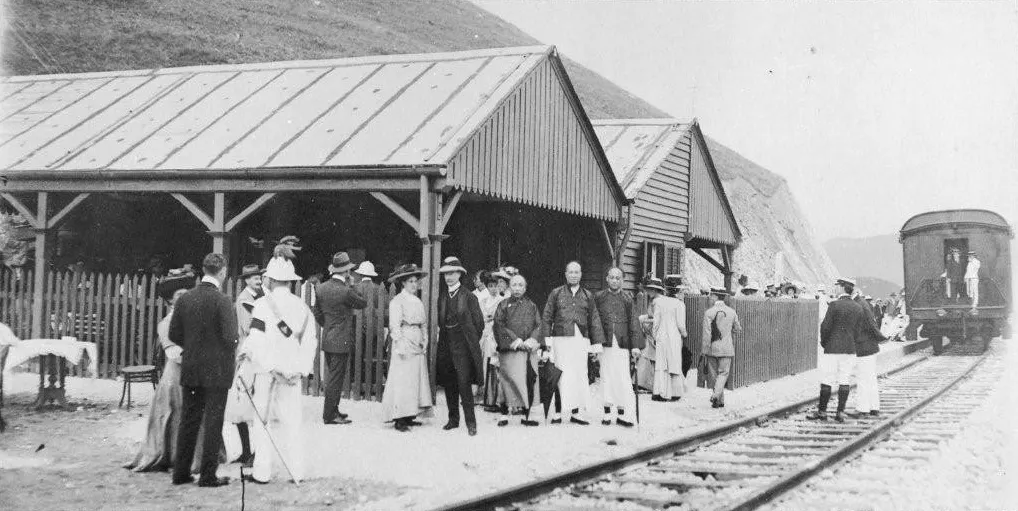
In 1949 the Chinese civil war pushed many refugees into Hong Kong, and the Government estimated the population at 1.86 million. In 1950 it built a checkpoint at Lo Wu and began erecting a wire fence along the Guangdong boundary, ending the previous unrestricted movement of people. On 15 June 1951 it sealed the boundary under a closed-area order, covering Chung Ying Street in Sha Tau Kok, and required residents to hold permits to enter or leave.
This was not merely “adding a fence”. Checkpoint, wire, closed area and permit together turned a geographical line into daily administration: who may cross, with what documents, when they return, and how people living in the border zone go about their lives. On 28 August 1967 the Government added a second wire fence to block illegal immigration, showing that the system would be strengthened as conditions changed.
3. 1956–1962: quotas relaxed, restored and mass crossings
The border regime was never fixed. On 10 February 1956 Hong Kong and the mainland revised crossing policy and removed the quota for Guangdong residents entering Hong Kong. On 3 September the Hong Kong Government restored entry quotas, requiring the number admitted to equal the number departing. During the roughly seven months of relaxation, about 54,000 people came from the mainland. The figure shows how quickly movement can change when policy loosens, and how quickly a channel can close when it tightens.
On 5 May 1962 Bao’an County in Guangdong relaxed controls on residents travelling to Hong Kong. The county estimated that between 27 April and 8 July about 80,000 people crossed its border outwards, of whom about 58,810 were later repatriated by the Hong Kong Government. Both are estimates, and different agencies may have used different categories; this dossier lists them without treating them as exact census counts. The crossing wave also brought accommodation, repatriation and social tension, and cannot be reduced to a single cause.
4. 1974–1980: reached base and immediate repatriation
From 30 November 1974 an arrangement between Guangdong and Hong Kong allowed illegal immigrants who reached the urban area south of Boundary Street and could contact relatives or find accommodation to stay. This was the “reached base” policy. Its logic used the urban area as the line: reach the city and you had a chance to remain; stop short and you could be repatriated. The design inevitably encouraged people to leave the border zone quickly and created a de facto finish line between the frontier and the city.
In October 1980 the Government abolished the policy and adopted immediate arrest and repatriation: all illegal immigrants were to be sent back. The change was connected to population pressure, job competition and border management, but the specific policy reasoning requires the files of the time, which this dossier does not supply. What can be said is that population grew markedly between 1971 and 1981, partly because many mainland arrivals settled before the policy was abolished; when it changed, the composition of growth changed with it.
5. 1991–1999: one-way permits and the right of abode
From 1991 to 2000, 452,000 people settled in Hong Kong under the One-way Permit scheme. The permit is not a tourist or business visa: it is a long-term settlement quota, approved on the mainland and received by Hong Kong. The scheme ties family reunion, population planning and border control together, and made the “daily quota” a public number. A quota, however, says only how many; it does not describe approval criteria, waiting time or the reality of separated families.
On 29 January 1999 the Court of Final Appeal ruled in Ng Ka Ling that “persons from other parts of China” in the Basic Law did not cover those who already enjoyed the right of abode, so they could not be repatriated. The Government then estimated that as many as 1.675 million mainland residents might qualify. On 26 June 1999 the NPC Standing Committee interpreted Article 22 of the Basic Law, requiring mainland residents to hold both a one-way permit and a right-of-abode certificate to acquire the right of abode in Hong Kong. The episode involved courts, the Government and a central legislative interpretation; this dossier states the registered entries and does not reduce it to “who was right”.
6. 2008–2020: a shrinking closed area and new crossings
The border regime did not freeze after 1997. From 2008 to 2016 the Government progressively lifted land restrictions in the frontier closed area, reducing it to about 400 hectares; on 15 February 2012 the first reduction phase began. On 26 August 2020 cargo facilities opened at the Liantang/Heung Yuen Wai boundary control point, Hong Kong’s seventh land crossing. From sealing the boundary to shrinking the closed area and adding crossings, the border’s function shifted gradually from isolation towards managing flow.
A smaller closed area, however, is not an open border. The zone still contains residents, land uses, ecology and enforcement questions; new crossings bring transport, environmental and regional planning effects. This dossier does not reduce the border to “more open is better” or “more closed is safer”; both skip the institutional design. The better questions are whose objectives border management serves, who bears the cost, and how rights and restrictions on movement are defined.
Gaps
- Vietnamese boat people, non-refoulement claims and torture claims are not covered.
- One-way permit approval criteria, waiting times and the reality of separated families are not included.
- The demographic effects of foreign domestic helpers, talent and student visas are not checked item by item.
- Cross-boundary passenger flows, cross-boundary schooling and employment, and checkpoint capacity are not compared from official statistics.
- Post-2020 checkpoint operations and quarantine arrangements lie outside this dossier.