Long-form / 深度專題
體育:由馬場與球會到奧運獎牌
Sport: from racecourse and clubs to Olympic medals
香港嘅體育,係幾時由僑民嘅會所活動變成代表香港嘅競技?
香港最早嘅現代體育組織由僑民同軍人帶來;賽馬、足球都先有會所,後有總會。要到戰後,香港才以自己名義派隊參加奧運同亞運,再過四十幾年才有第一面奧運金牌。呢篇把「會所—總會—代表隊—場地」四步分開講,每步接得返原書頁碼。
約 4 分鐘 · 6 節 · 15 條時間線 · 2 份文獻
English
1. Racing: from expatriate pastime to institution and charity
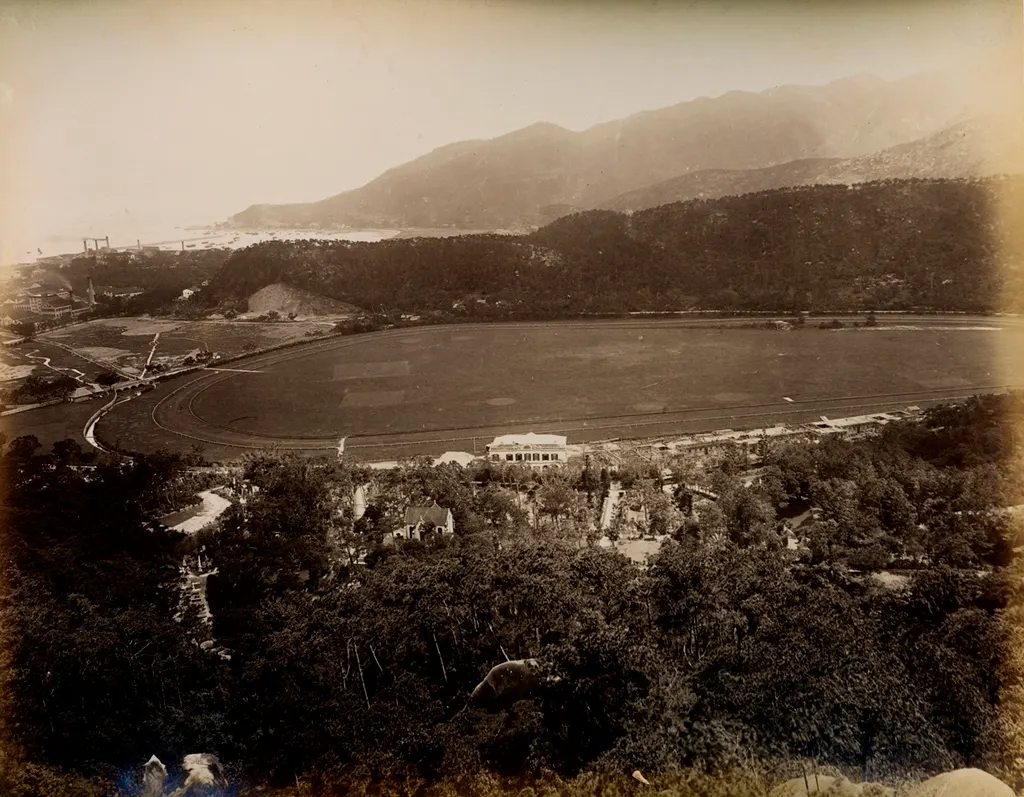
Hong Kong’s earliest modern sport came with expatriates and servicemen rather than growing from local communities. In 1845 the Happy Valley racecourse was completed, the first racecourse in Hong Kong, and racing was then a social occasion for expatriates and the military. Only on 4 November 1884 did 34 non-Chinese businessmen and Legislative Council members gather at the City Hall and propose a Hong Kong Jockey Club, on the argument that racing should be coordinated by a long-standing organisation instead of being arranged afresh each year. That step was about institutionalisation: a one-off event became a body with membership, a course and a fixed calendar.
Institution brought scale, and scale brought risk. On 26 February 1918, the second day of the annual races at Happy Valley, the bamboo scaffolding of the upper grandstand broke and collapsed onto the food stalls below; stoves overturned, bamboo caught fire and the flames spread rapidly, leaving 570 dead and 135 missing. It remains the worst disaster in Hong Kong sporting history and turned temporary structures and crowd management from technical details into questions of public safety.
After the war the Jockey Club’s role widened from running races to providing venues and charitable resources. Sha Tin Racecourse opened on 7 October 1978, with six races that day and a capacity of over 83,000. Moving from one course in Happy Valley to a second in the New Territories reflected not only the popularity of racing but also changes in land use and transport: a racecourse fills only if people can get there.
2. Football: from club cup to association
Football came a generation after racing. On 12 February 1886 the Hong Kong Football Club was founded by Colonial Secretary James Stewart Lockhart together with British expatriates and servicemen, becoming the territory’s first football organisation. Nine years later, on 12 November 1895, the club organised the first Hong Kong Football Challenge Cup — the earliest tournament of its kind in Asia — renamed the Hong Kong Football Silver Shield in 1896. A club-run cup was quick to arrange, but its limit was that it reached only the membership circle.
The next layer was an association. The Hong Kong Football Association was formally founded in 1914. Between a club cup and an association running leagues and representative teams lie registration, promotion and relegation, player eligibility and fixture scheduling: football moved from a social activity to an administered competition. This dossier does not add league sizes or attendance, because those figures are not verified season by season; the timeline stops at the founding of the association.
3. Representing Hong Kong: from taking part to winning medals
Hong Kong’s first appearance on the international stage came on 19 July 1952, when a team travelled to Helsinki for the 15th Olympic Games. There was no medal, but taking part was itself a question of status: a colony sending a team in its own name is not the same as competing as part of the metropolitan country.
The first medal came at the Asian Games. On 5 May 1954 the athlete Xavier won bronze in the 200 metres, Hong Kong’s first Asian Games medal. In disability sport, Hong Kong first sent a delegation to the 4th Paralympic Games in Heidelberg on 3 August 1972, where table tennis player Lam Lung took silver in the men’s singles and bronze in the men’s doubles with Lee Kwun-hung.
Gold took longer. On 26 September 1986 Che Kuk-hung won Hong Kong’s first Asian Games gold in the women’s individual bowling event. A decade later, on 29 July 1996, Lee Lai-shan won gold in the women’s windsurfing at the 26th Olympic Games in Atlanta — Hong Kong’s first Olympic gold. From first participation in 1952 to first gold in 1996 lies a span of forty-four years, which shows that taking part and winning medals are different stages, the second depending on long accumulation of venues, coaching and talent identification.
4. Venues and hosting: from training to staging events
On 31 October 1982 the Jubilee Sports Centre began operation. Built on 41 acres of land provided by the Jockey Club, it aimed to nurture Hong Kong athletes and was the first local sports venue meeting international specifications. That marked a change of direction: resources moved from staging events for spectators to training people and raising standards. Venues come before systematic training, and systematic training comes before consistent results.
Hosting is a different capability. On 9 August 2008 Hong Kong co-hosted a Summer Olympic event for the first time, with the equestrian competitions of the 29th Olympiad held that day; a year later, on 5 December 2009, the 5th East Asian Games opened in Hong Kong. Co-hosting an Olympic event and staging a regional multi-sport games make different demands on venues, volunteers, transport and drug testing, but both face the same question: what happens to the venue after the event, so that it does not become a one-off build.
5. How to read the sources
The racing thread runs through the Hong Kong Chronicles chronology at p.133 (racecourse completed), p.168 (the Jockey Club proposal), p.206 (the racecourse fire) and p.416 (Sha Tin opening). Football sits at p.169 (Hong Kong Football Club), p.180 (first Challenge Cup) and p.203 (the football association). International competition is at p.286 (first Olympics), p.296 (first Asian Games medal), p.379 (first Paralympics), p.468 (first Asian Games gold) and p.532 (first Olympic gold).
Venues and hosting are at p.443 (Jubilee Sports Centre), p.651 (Olympic equestrian events) and p.659 (East Asian Games opening). Hong Kong Chronicles, Nature: Territory, Geography and Population, records Happy Valley as an early recreation ground and the opening of Sha Tin Racecourse (p.95, p.138, p.141), which is useful for linking venues to new town development. For primary records, go next to Jockey Club annual reports, sports association yearbooks and LCSD venue statistics rather than event press releases.
6. Gaps
This dossier does not tackle the amateur–professional boundary: the years in which football moved towards professionalism, player pay and import rules, and the league scale of team sports such as basketball and volleyball are all unverified and therefore omitted.
Athlete numbers, elite-training funding and the relationship between medals and resources are also not registered year by year. These are exactly the figures that read smoothly but cannot be traced, so they are left blank until official annual reports are available.
Gaps
- Athlete numbers, elite-training funding and medal counts are not registered year by year, nor is the allocation of resources between disability sport and mainstream sport addressed.
- The years in which football moved towards professionalism, player pay, import rules and league attendance are not verified season by season and therefore do not appear in the prose.
- Betting turnover, charitable donations and horse numbers have no registered official series here; the dossier covers institutional milestones only.
- School sport, community sport and LCSD venue utilisation are excluded because the official statistical definitions for those three lines are not consistent.
- Individual athlete biographies — birthplace, training background, coaches — are not checked person by person; the dossier relies only on the events and medals recorded in the official chronology.
- The cost, overruns and post-event utilisation of major events are not verified item by item and are not assessed.