Long-form / 深度專題
教育:由少數人的英文書院到全民強迫教育
Education: from a few English colleges to universal compulsory schooling
香港嘅學校制度,點解會由「挑選少數人」變成「所有人讀到初中」?
1842 年,馬禮遜紀念學校帶住 11 名學生由澳門遷到摩利臣山;1978 年,全港實施九年強迫教育。中間每一步——考試、資助、教學語言、學制——都同時回答兩個問題:邊個有書讀,以及讀完之後可以去邊。
約 4 分鐘 · 6 節 · 16 條時間線 · 4 份文獻
English
1. Mission schools and the central college: schooling for a few
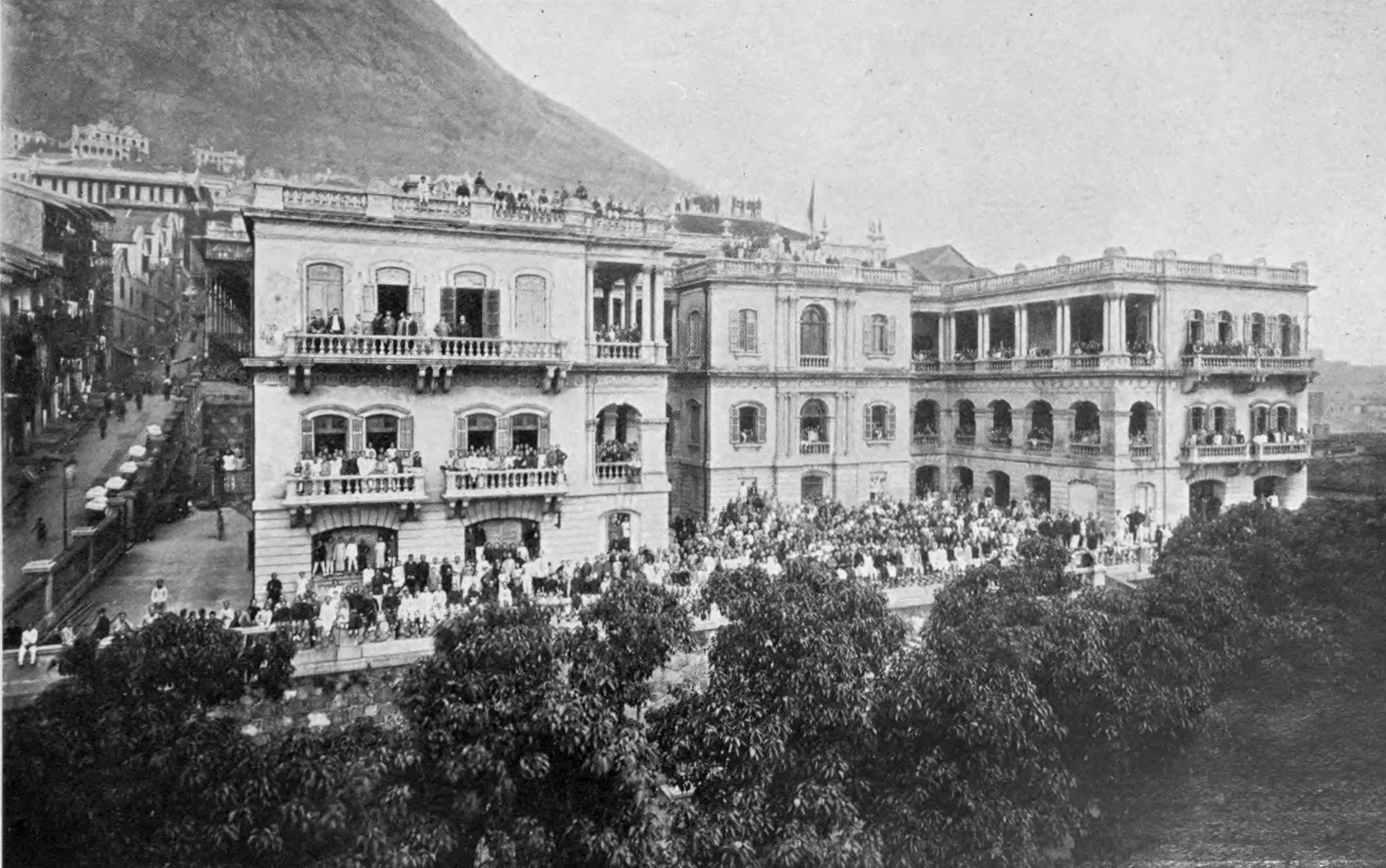
Early schooling in Hong Kong was not the product of a single colonial plan. Missions, charities and the Government each supplied a piece. On 1 November 1842 the Morrison Memorial School moved from Macau to Morrison Hill; its headmaster, Rev. Brown, arrived with 11 students including Wong Shing, Yung Wing and Wong Fun, and the record calls it Hong Kong’s first English college. Its significance lies less in being first than in linking English, Christian education and a small Chinese elite to further study and employment.
On 4 March 1862 the Government consolidated four Royal Libraries into the Central School, today’s Queen’s College, with Frederick Stewart as first headmaster; Ho Kai, Wei Yuk and Sun Yat-sen were among its alumni. From mission school to government central college, the system began to split: one strand served mission and charity, the other trained people who could handle public business and commerce in English. On 1 October 1887 the Hong Kong College of Medicine for Chinese opened within the Alice Memorial Hospital, with Sun Yat-sen among its first graduates; the college was later incorporated into the University of Hong Kong, tying professional training to the university from the start.
2. The university and Chinese education: two claims to legitimacy
On 31 March 1911 the University of Hong Kong was established under the University Ordinance 1911; its Main Building opened on 11 March 1912, and about 50 students entered in September that year. For the first time Hong Kong had a local degree-granting institution, giving secondary schooling a clear destination. A university, however, was not the same as Chinese education: on 1 March 1926 the Government Vernacular Middle School opened as the first Chinese middle school run by the Government, renamed Clementi Middle School in 1951. That strand shows that beyond English elite schooling, there was demand for a secondary education completed in Chinese.
On 17 October 1963 The Chinese University of Hong Kong held its inauguration at Hong Kong City Hall, formed by New Asia, Chung Chi and United colleges; Li Choh-ming was appointed first Vice-Chancellor that November. CUHK was not merely “one more university”: it joined Chinese-language teaching, the college tradition and a local degree system. Between 1911 and 1963 higher education went from one institution to two, but places remained scarce. What turned schooling into a mass experience was the later free compulsory system, not university expansion by itself.
3. Examinations: the machine that allocated opportunity
As schooling expanded, someone had to decide who moved up. In June 1935 the University of Hong Kong held the first local secondary school leaving certificate examination: 691 candidates, 243 passes. The figures show that secondary graduation was already a minority experience, and progression to university rarer still. Examinations did more than measure attainment; they fixed the curriculum and gave schools a target. Schools taught for the examination, and families chose schools with it in mind.
In 1949 the Education Department created the Primary School Leaving Examination to select primary leavers for secondary places. On 5 September 1961 it announced that the examination would end in 1962 and be replaced by the Secondary School Entrance Examination. The name changed, the function did not: while places were scarce, one test sorted students. The real break came with nine-year compulsory education in 1978. Once junior secondary became a right rather than a prize, the examination’s role shifted from whether you could continue to which school you attended.
4. 1971 and 1978: turning schooling into a right
In 1971 Hong Kong introduced six years of free compulsory primary education. On 5 October 1977 the Governor announced in the Legislative Council that free compulsory junior secondary education would begin ahead of schedule in 1978/79. In September 1978 nine-year compulsory education took effect: six free primary years plus three free junior secondary years. The weight of the change was not merely that the Government paid fees, but that primary graduation stopped being a possible endpoint and became a required stage.
Compulsory schooling also changed the ecology of schools. Government and aided secondary schools had to take all primary leavers, so differences between schools shifted from whether they admitted you to where you were allocated. Family strategy changed too: first the goal was a place, then a good place. That competition continues today in the form of secondary school places allocation, school nets and school-based assessment. Without this distinction, “free” is easily misread as “equal”.
5. Medium of instruction and 3-3-4: the system changes again
On 25 September 1997 the Education Department published the Medium of Instruction Guidance for Secondary Schools, requiring Chinese as the medium of instruction in Secondary 1 in government and aided schools from 1998/99. The decision turned medium of instruction from a school-level arrangement into central policy, and made “English-medium school” a status requiring approval. Language policy was never merely a teaching technique: it affected progression, parental choice and school labels, and left some students navigating between Chinese teaching and English examinations.
In May 2005 the Education and Manpower Bureau published its new academic structure report, implementing the 3-3-4 system for senior secondary and higher education. On 1 September 2009 the Education Bureau applied the new senior secondary structure at Secondary 4, allowing students to articulate to four-year university programmes. The reform cut secondary schooling from seven years to six and lengthened university from three to four, replacing two public examinations with one. The structure became uniform, but competition did not disappear: it moved from two hurdles to one diploma, alongside school-based assessment and university admissions.
6. The limits of this dossier: system history is not school history
This dossier covers the system: who could enter, who paid, what language was used, which examination sorted students. It does not pretend to narrate every school in Hong Kong, nor does it treat policy aims as outcomes. After nine-year compulsory education, questions such as dropout, special educational needs, support for newly arrived children and overcrowding still require official statistics item by item; this dossier does not have enough registered entries to settle them.
Likewise, Diploma of Secondary Education results, university admission rates, the quality of associate degree and self-financing programmes, and teachers’ workloads after 3-3-4 lie outside this dossier. Each needs its own official source and cannot be inferred from a handful of chronology entries. Depth here means linking verified nodes into causes and consequences, not stating unverified controversies more confidently.
Gaps
- Prevocational schools, special schools, international schools and direct-subsidy schools are not covered.
- Official statistics on class sizes, teacher ratios, education spending and school places are not included.
- DSE results, university admission rates and the quality of associate-degree and self-financing programmes are unverified.
- The actual effect of medium-of-instruction policy on students from different backgrounds is not supported by school-level data.
- Dropout rates and special educational needs support after nine-year compulsory education are not checked item by item.